
Japan’s Evolving Economy: What Investors Are Watching
Japan blends ancient traditions, breathtaking natural landscapes, a world-renowned culinary scene and modern innovation seamlessly. On-the-ground value is exceptionally high due to the favorable exchange rate, high safety standards, and an abundance of free cultural attractions. With six airlines offering non-stop service from the US, United Airlines, Delta Air Lines, American Airlines, Japan Airlines, All Nippon Airways, and ZIPAIR, you should be able to find a bargain whether you use points or pay with cash. While Kyoto and Tokyo are frequented by many American tourists, you might also want to explore some smaller cities. Japan is made up of 47 prefectures (administrative regions) offering many different experiences.
 .
. 
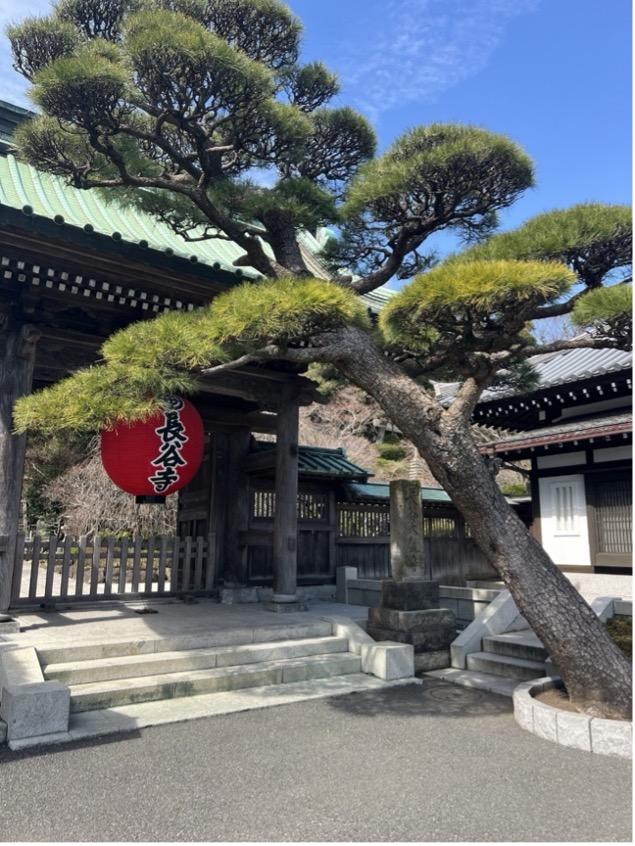
Left: Main entrance gate of Hase-dera Temple (長谷寺) in Kamakura, Japan. The large red lantern reads “長谷寺,” and the sculpted pine tree leaning across the gate is one of the temple’s recognizable features. Right: Takeshita Street, Tokyo. Photos taken by Ryan Scharar, President of FCA Corp.
Japanese Yen: More Than a Travel Advantage
One factor making Japan more affordable for American travelers is the depreciation of the yen, illustrated in the one-year yen-to-dollar exchange rate chart below.

Chart Source: Bloomberg LP
Japan may also offer investor value that many overlook. To understand why, you need to look at the structural, political, and demographic issues, as well as the country’s future needs.
Political and Geopolitical Developments
On October 21, 2025, Ms. Sanae Takaichi, considered a hardline conservative, became the first female Prime Minister of Japan, marking a historic moment for the country. Political stability under Prime Minister Sanae Takaichi focuses on economic revitalization and addressing the “successor problem” for small businesses. She has a pro-Taiwanese foreign policy and supports strengthening the US-Japan Alliance.
Military activities by Japan’s three nuclear-armed neighbors — China, Russia, and North Korea — have been particularly noticeable since the outbreak of the Russia–Ukraine War. China–Russia joint military exercises, the expansion of the operational range of Chinese aircraft carrier strike groups, and the so-called grey zone infiltration of Japanese society offer additional reasons for concern. These grey-zone provocations or aggressions stop short of the threshold of conventional war and include maritime intrusions, cyber disruptions, withholding key rare earth minerals, and other trade interference.
Among the top geopolitical risks in 2026, the biggest ones for Japan are those affecting its economy, according to the Eurasia Group. Japan is under economic pressure from inflation, a weak yen, and a growing debt burden (with interest rates at a 30-year high). Although Prime Minister Takaichi Sanae’s approval ratings are remarkably strong, if she fails to address voters’ economic concerns, those numbers could fall quickly. Takaichi has a tough task in tackling the high cost of living—a top issue for voters—without tipping the weak economy into recession. And the implications of several of this year’s risks (such as China’s deflationary economy, US-Japan trade and investment relations, and the impact of US-Mexico-Canada trade negotiations on Japanese firms) do not make her job any easier.
Japan’s Market and Economic Outlook
Japan’s stock market (primarily represented by the Tokyo Stock Exchange) has a total market capitalization of roughly $8.3 Trillion USD as of June 30, 2026. It consistently ranks as the world’s 3rd- or 4th-largest stock exchange, with nearly 4,000 listed companies, and the TOPIX (Tokyo Stock Exchange Price Index) and Nikkei 225 serve as its main indices.
The Topix performance for the one-year period ending June 30, 2026, is reflected in the chart, which compares performance in dollars and yen.
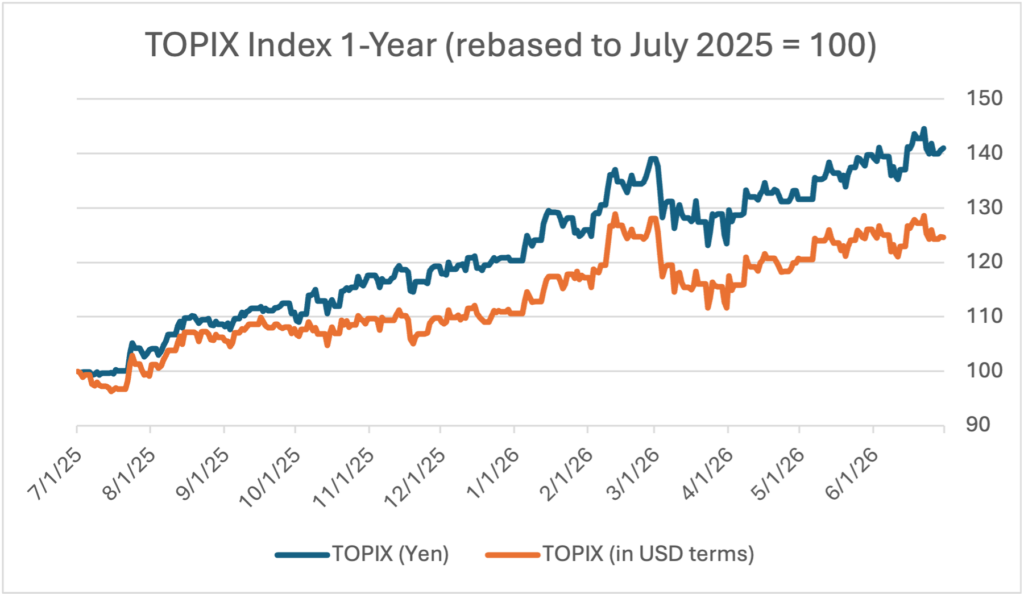
Chart Source: Bloomberg LP
Japan has the financial resources to compete and diversify offshore. For example, major US insurance companies are owned by Japanese conglomerates. These companies operate as subsidiaries of Japan’s big insurers, providing commercial, specialty, and property & casualty insurance. This trend can continue in other countries and industry sectors. We also see sales of Japanese-manufactured defense equipment growing in both domestic and export markets. Japan is participating in the AI infrastructure by supplying many key components, according to The Economist.
Innovation and AI
Corporate governance reforms, earnings growth, and pro-growth government policies can be key drivers in building market performance. This economic performance can be enhanced by Japan’s highly prized cultural leanings toward diligence, responsibility, and punctuality, if applied to business activity. AI might also help address some of the population demographic challenges. If JETRO (Japan External Trade Organization) is correct about Japan being the gateway to global innovation, Americans investing in the Japanese market could be rewarded.